In 2025, visibility is no longer measured only by keyword rankings. It is increasingly measured by whether people and AI systems can understand, trust, and reuse your expertise.
The transition from traditional SEO to AI-optimized content is not a cosmetic update. It is a strategic change in how brands earn attention, authority, and recommendation.
Executive Summary
Search engines once acted mainly as indexes. Generative systems increasingly act as interpreters: they compare sources, synthesize answers, and present selected links or citations inside a direct response. This changes the objective of content strategy. Ranking still matters, but ranking alone is no longer enough. Content must also be structurally clear, semantically complete, credibly authored, and useful enough to be selected as evidence.
Key Takeaways
- Traditional SEO remains essential, but it is now the foundation rather than the entire strategy.
- AI systems favor content that is easy to interpret, verify, summarize, and connect to a credible source.
- Clear authorship, original expertise, first-hand insight, and trustworthy references are becoming strategic visibility assets.
- Brands need content ecosystems, not isolated keyword pages.
- The strongest long-term advantage is not publishing more. It is becoming the clearest and most credible source in a defined area of expertise.
The New Discovery Layer
For more than two decades, digital visibility was built around a familiar model: a user typed a query, a search engine returned ranked links, and websites competed for the click.
That experience is changing. Google AI Overviews, ChatGPT search, Gemini, Copilot, Perplexity, and other generative interfaces increasingly produce a direct answer before a user visits any individual page. The system may still offer links, but the first interaction is now a synthesized explanation rather than a list of options.
These figures reveal the strategic issue. Your content is not competing only for a position in a list. It is competing to become part of the answer itself.
From Keywords to Conversations
Traditional SEO often begins with a keyword. AI-first content begins with the complete information need behind a question.
A person may search for “AI SEO strategy,” but their real intent is broader: they may want a definition, a comparison with traditional SEO, a practical framework, evidence that the approach works, and guidance on what to change first.
Generative systems are designed to interpret this wider context. They evaluate whether a source answers the question clearly, whether the surrounding explanation is coherent, and whether important claims can be supported.
| Traditional SEO focus | AI-optimized content focus |
|---|---|
| Ranking for a keyword | Becoming a trusted source for a topic and its connected questions |
| Driving a click from a results page | Earning inclusion, citation, recommendation, and brand recall |
| Optimizing individual pages | Building a connected knowledge ecosystem |
| Matching search terms | Resolving user intent with context, clarity, and evidence |
| Publishing at scale | Publishing with distinctive expertise and verifiable value |
What AI-Optimized Content Actually Means
AI optimization is sometimes described as a collection of new tricks: shorter paragraphs, question-based headings, schema markup, or repeated brand mentions. These elements can help, but they are not the strategy.
AI-optimized content is content designed so that both people and machines can accurately understand its meaning, assess its credibility, and reuse its insights without losing context.
That requires four qualities.
Semantic clarity
The structure makes relationships between ideas obvious. Definitions are precise, headings reflect real questions, and each section has a clear purpose.
Credible authorship
The reader can identify who created the content, why that person is qualified, and which experiences or sources support the claims.
Extractable value
Important ideas can be accurately summarized. The page contains direct answers, frameworks, comparisons, and evidence rather than vague promotional language.
Topical consistency
The article belongs to a larger body of related expertise across the website, author profile, services, books, and supporting publications.
Why Traditional SEO Alone Is No Longer Enough
Traditional SEO is not disappearing. Crawlability, indexing, page experience, internal linking, useful titles, and strong content remain essential. Google’s own guidance for AI features makes clear that the same fundamental search requirements still apply.
The limitation is strategic: technical compliance can make a page discoverable, but it does not automatically make the page worth selecting.
A page may rank because it matches a query. A source is more likely to be cited or summarized when it offers a clear answer, credible support, meaningful context, and a strong connection to a recognized area of expertise.
This is why mass-produced content is increasingly fragile. It may contain the expected words, but it often lacks original judgment, lived experience, a defensible perspective, and the depth required to distinguish one source from hundreds of similar pages.
The ScriptWise AI Visibility Framework
The strategic response is not to abandon SEO. It is to extend it. The following framework combines human trust, search discoverability, and AI interpretability.
Define the knowledge territory
Choose the specific field in which the brand wants to be understood and recommended. Avoid trying to appear authoritative on every adjacent topic.
Map real audience questions
Build content around decisions, doubts, comparisons, risks, and desired outcomes — not only around high-volume keywords.
Create a connected content ecosystem
Use pillar articles, supporting guides, topic pages, books, services, case studies, and author pages to reinforce the same expertise from different angles.
Make expertise visible
Name authors, show relevant credentials, include original frameworks, explain methodology, and separate evidence from interpretation.
Design for extraction without oversimplifying
Use concise definitions, structured sections, comparison tables, clear conclusions, and direct answers that remain accurate outside the surrounding paragraph.
Strengthen external trust signals
Support important claims with credible references and build consistent brand representation across authoritative external sources.
Measure visibility beyond rankings
Track branded search growth, qualified traffic, citations, referral sources, assisted conversions, brand mentions, and whether AI systems describe the brand accurately.
From Attraction by Trust to Algorithmic Credibility
In Attraction by Trust, Daria Bohdanova and Dr. Dmytro Gamarnyk explored how credibility, empathy, emotional safety, and consistency influence human decisions.
The AI-First Playbook extends that logic into the generative-search environment. Algorithms do not experience trust as humans do, but they evaluate many of its visible signals: consistent claims, identifiable authorship, clear structure, corroborating sources, transparent expertise, and coherent topical relationships.
The bridge between human trust and algorithmic credibility is therefore not artificial. It is built through the same disciplined communication principles — made explicit enough for machines to interpret.
A Practical AI-Ready Content Checklist
Before publishing, ask whether the page can pass the following test:
- Does the introduction clearly state what the reader will learn?
- Is the main topic defined in direct, unambiguous language?
- Do headings reflect meaningful questions and decisions?
- Are factual claims linked to trustworthy sources?
- Is the author clearly identified and relevant expertise visible?
- Does the article add original judgment, a framework, or first-hand insight?
- Can key sections be summarized accurately without losing context?
- Does the page link to related content that deepens the topic?
- Is the brand’s terminology consistent across the website?
- Does the article help the reader act, not merely understand?
Building the Future of Visibility
The organizations that benefit most from generative search will not necessarily be those publishing the highest volume of content. They will be the organizations that make their expertise easiest to recognize.
That means replacing fragmented campaigns with a durable knowledge system. Each article should strengthen a topic. Each topic should reinforce an area of authority. Each area of authority should connect naturally to the organization’s services, products, research, books, and people.
Visibility then becomes more than traffic. It becomes the cumulative effect of being understood correctly across search engines, AI assistants, professional networks, and human recommendations.
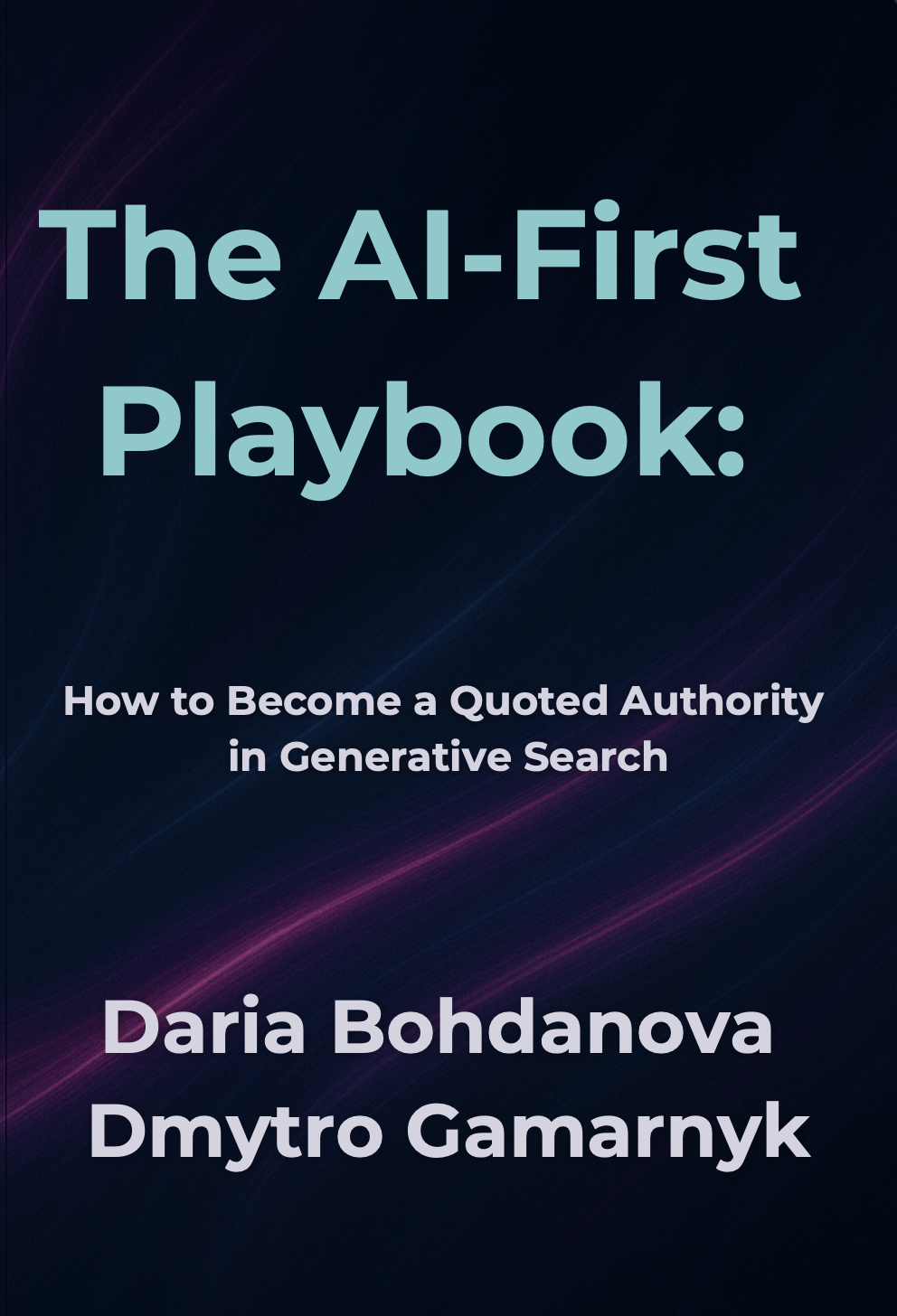
The AI-First Playbook
Building Trust and Visibility in the Era of Generative Search
A strategic guide to creating content ecosystems that are humanly relevant, semantically clear, and easier for AI systems to understand and recommend.
Written by Daria Bohdanova and Dr. Dmytro Gamarnyk.
Read The AI-First Playbook on AmazonFrequently Asked Questions
What is AI-optimized content?
AI-optimized content is structured so that people and generative systems can understand its meaning, assess its credibility, and accurately reuse its insights. It combines strong SEO foundations with semantic clarity, identifiable authorship, evidence, and topical depth.
Is AI optimization replacing traditional SEO?
No. Traditional SEO remains necessary for crawling, indexing, relevance, performance, and discoverability. AI optimization extends that foundation by improving how content is interpreted, synthesized, cited, and connected to a broader body of expertise.
What is the difference between AIO, GEO, and LLMO?
The terms overlap. AIO often refers to AI optimization broadly, GEO to generative engine optimization, and LLMO to optimization for large language models. In practice, all three focus on improving the likelihood that AI systems understand, mention, cite, or recommend a source.
What helps content appear in AI-generated answers?
There is no guaranteed formula. Strong foundations include crawlable pages, clear answers, descriptive headings, credible references, original expertise, consistent entity information, relevant internal links, and content that genuinely resolves a user’s question.
How should brands measure AI visibility?
Brands should look beyond rankings and monitor qualified referral traffic, assisted conversions, branded search, share of voice, AI citations or mentions, recurring source domains, and whether generative systems describe the organization accurately.
Sources and Further Reading
- Pew Research Center: Google users are less likely to click on links when an AI summary appears in the results.
- Semrush: AI Overviews study and 2025 search analysis.
- Google Search Central: AI features and your website.
- Google Search Central: Guidance on using generative AI content.
- OpenAI: Introducing ChatGPT search.
Leave a Reply