AI search does not reward the website that publishes the most. It rewards the source that makes meaning easiest to retrieve, verify, and reuse.
The future of visibility is not a content-volume race. It is an information-design problem.
The core idea
More content creates more surface area. Structured thinking creates retrievable meaning. AI systems need the second far more than the first.
The content problem is often a thinking problem
I keep seeing the same recommendation: publish more.
More articles. More landing pages. More FAQs. More posts. More content clusters.
Sometimes that is the right answer.
But often, the company already has enough material. What it lacks is a visible system of thought.
The website contains definitions that contradict one another. Product terminology changes from page to page. Questions are answered indirectly. Important claims are buried inside introductions. Comparison logic is implied but never stated.
Then the team adds another twenty articles to the same information disorder.
The result is not authority. It is a larger archive of uncertainty.
More content and better structure produce different outcomes
Volume-first strategy
Structure-first strategy
What structured thinking means in AI search
Structured thinking is not merely formatting. Headings, tables, and FAQ blocks help, but they cannot compensate for weak reasoning.
Real structure begins before the page is written.
Define the object
What exactly is being described: a product, process, method, category, service, or decision?
Define the relationship
How does this object relate to alternatives, users, stages, risks, and outcomes?
Define the answer unit
What part of the content could stand alone as a reliable response to one precise question?
Define the evidence
Which claims need proof, qualification, examples, dates, authorship, or direct source support?
From page production to answer architecture
Traditional content planning often starts with a list of titles. AI-first planning should start with a map of decisions.
What does the audience need to understand? What will they compare? What objections will appear? Which terms must remain stable? Which answer depends on context?
This sequence matters because generative search rarely treats a page as one indivisible object. It retrieves, compresses, combines, and reframes information.
If a useful answer is hidden inside 1,800 words of throat-clearing, the page may be valuable to a patient reader and still be difficult to reuse. If each section answers one recognisable question, the content becomes modular without becoming simplistic.
A note from The AI-First Playbook
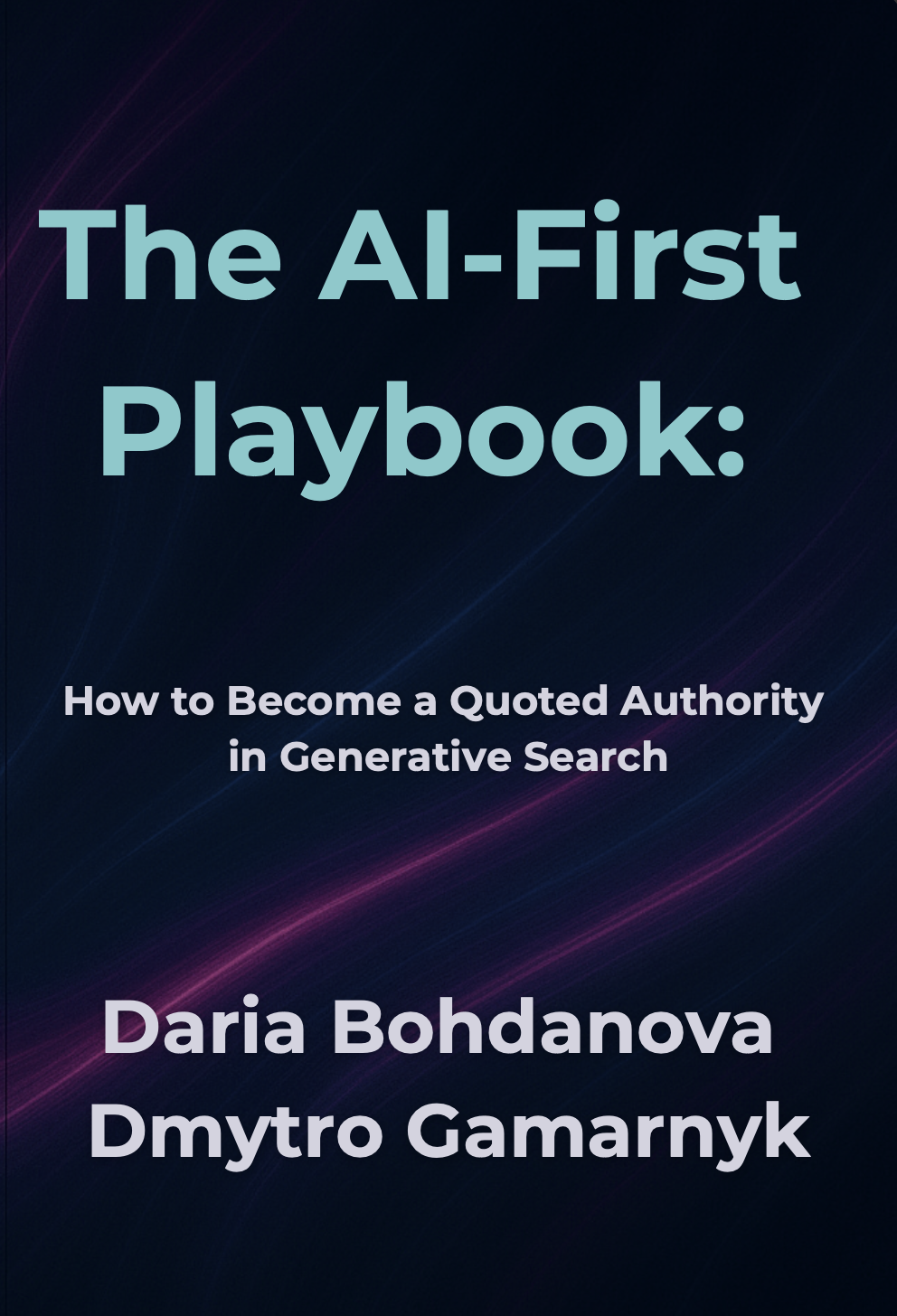
The AI-First Playbook: How to Become a Quoted Authority in Generative Search
By Daria Bohdanova and Dmytro Gamarnyk. The book develops the idea that visibility in generative search depends on clarity, intent, trust signals, and modular content design.
“AIO SEO is not a plugin or a tool. It’s a mindset.”
That line matters because many teams still approach AI search as a new optimization layer placed on top of old content operations.
They add schema, expand FAQs, run pages through another tool, and assume the problem has been solved.
But AI visibility is not created by one plugin or one checklist. It is created by an editorial system that makes knowledge coherent before it makes it searchable.
“Write like an architect, not a bricklayer.”
The five structures AI-ready content needs
| Structure | What it does | What happens without it |
|---|---|---|
| Entity structure | Clarifies who or what the page is about | Names, products, and categories blur together |
| Intent structure | Matches the answer to the user’s actual decision | The page is relevant in topic but useless in context |
| Semantic structure | Connects terms, concepts, alternatives, and consequences | AI sees isolated phrases rather than a coherent model |
| Evidence structure | Separates claims, examples, qualifications, and sources | Confident language appears unsupported |
| Navigation structure | Connects the page to the wider knowledge system | Strong pages remain isolated and authority does not compound |
Why content volume can reduce authority
Publishing more is not neutral.
Every new page can introduce another definition, another date, another naming convention, another unsupported claim, or another partial answer.
At small scale, this looks like inconsistency. At large scale, it becomes knowledge debt.
Knowledge debt is the distance between what an organization knows and what its content system can explain consistently.
- Multiple pages compete for the same question.
- Old articles remain live after the product changes.
- Writers create new terminology for existing concepts.
- FAQs answer the same objection differently across the site.
- AI-generated drafts multiply wording without strengthening the model underneath.
What AI can retrieve is shaped by what humans can maintain
This is where documentation strategy becomes central to AI search.
A well-maintained glossary, consistent product taxonomy, versioned documentation, clear ownership, and intentional internal linking create the conditions for reliable retrieval.
This is also the argument behind Product Documentation for Humans and AI: documentation is no longer written for one reader. It must help people complete tasks, help teams maintain knowledge, and help AI systems retrieve the correct answer without distorting the product.
AI search does not remove the need for documentation discipline. It exposes the cost of not having it.
A practical structure-first workflow
Audit questions, not pages
Collect the questions users, sales teams, support teams, and search systems repeatedly ask.
Map the answer ownership
Choose one primary page or module for each major question.
Normalize terminology
Decide which terms are official, which are synonyms, and where context changes meaning.
Design modular evidence
Use definitions, examples, tables, comparisons, FAQs, and source notes as reusable answer units.
Link by reasoning
Internal links should continue the user’s decision, not merely connect similar keywords.
Refresh the system
Update connected pages together when the product, evidence, or terminology changes.
Structure does not mean writing like a machine
One of the worst reactions to AI search is to make every page sound like a database.
Human readers still need rhythm, relevance, emotional calibration, and a reason to care.
The answer is not to remove narrative. It is to give narrative architecture.
A story can still have a clear problem, context, decision, and outcome. An essay can still contain quotable definitions. A deeply human page can still use stable terminology and visible evidence.
As explored in The Psychology Behind Good Product Copy, clarity reduces cognitive load and increases perceived control. The same structural choices that help AI interpret a page also help people trust it.
The real competitive advantage
The advantage is not publishing faster than everyone else.
AI has already made that advantage temporary. Every competitor can now generate more drafts, more variations, more outlines, and more pages.
The lasting advantage is having a clearer model of the subject than everyone else.
That model becomes visible through terminology, hierarchy, comparison, evidence, and internal connection.
It becomes the reason your content can be quoted without being misunderstood.
When a long page is reduced to three sentences, does the central idea remain accurate? When a comparison is summarised, does the distinction survive? When a definition is retrieved alone, does it still make sense?
Structured thinking is what makes the answer yes.
Continue Through the ScriptWise Knowledge Hub
Frequently Asked Questions
What does structured thinking mean in AI search?
It means organizing knowledge around clear entities, relationships, questions, answer units, evidence, and user decisions before turning that knowledge into pages.
Does publishing more content improve AI visibility?
Only when the new content adds distinct, accurate, and well-connected knowledge. Repetition and overlap can make a site harder to interpret and maintain.
What makes content easier for AI to retrieve?
Clear headings, direct answers, stable terminology, comparison tables, FAQs, authorship, evidence, current information, and strong internal connections all improve retrievability.
Is structured content the same as formulaic content?
No. Structure organizes meaning. Formulaic writing repeats surface patterns. Strong content can be personal, narrative, and original while still having a clear information architecture.
What should a company fix before producing more content?
It should audit terminology, duplicated topics, outdated pages, unanswered user questions, internal linking, evidence quality, and ownership of core answers.
Leave a Reply