Modern product documentation is no longer written for one reader. It must help a human complete a task, help a team maintain product knowledge, and help AI systems retrieve the right answer without distorting the product.
That changes documentation from a writing deliverable into product infrastructure: versioned, searchable, measurable, and designed around real user decisions.
The Core Idea
Documentation shapes how a product is understood, adopted, supported, trusted, and increasingly how it is interpreted by AI. The strongest documentation system does not choose between human readability and machine readability. It creates one governed source of truth from which both can reliably learn.
Documentation Is Product Infrastructure
A help center is often treated as the place where finished information goes. That is too late and too narrow. Documentation begins when product logic is defined: what the feature does, which states exist, what can fail, which permissions apply, and what the user should expect next.
When that logic is unclear, documentation exposes the problem. A writer cannot create a stable explanation from unstable product decisions. At senior level, technical writing therefore includes discovery, requirement clarification, terminology governance, information architecture, review design, and release coordination.
This is also why documentation affects more than support. It influences onboarding, implementation speed, feature adoption, developer experience, customer confidence, internal alignment, and the accuracy of AI-generated answers.
Humans and AI Need Different Things From the Same Source
A human usually arrives with a task, a deadline, and partial context. They need orientation, examples, prerequisites, recovery paths, and confidence that the instruction applies to their situation.
An AI system works differently. It retrieves fragments, matches concepts, identifies entities, and composes an answer from available evidence. It benefits from stable terminology, explicit relationships, predictable headings, self-contained procedures, structured metadata, and content that does not depend on hidden context.
The solution is not to maintain separate “human” and “AI” documentation. That creates drift. The better model is a single source with layered outputs.
The Four Content Types Must Remain Distinct
One of the most common documentation failures is mixing explanation, instruction, learning, and reference on the same page. The result may be technically complete but cognitively expensive.
| Content type | User need | Typical output |
|---|---|---|
| Tutorial | “Help me learn by doing.” | A guided first success with controlled scope. |
| How-to guide | “Help me complete this task.” | Goal-oriented steps with prerequisites and outcomes. |
| Explanation | “Help me understand why this works.” | Concepts, trade-offs, architecture, and mental models. |
| Reference | “Give me the exact facts.” | Parameters, schemas, constraints, errors, and defaults. |
Microsoft’s reference-documentation guidance emphasizes consistency, predictable structure, and related links because developers need to locate exact information quickly. GitHub’s documentation guidance similarly starts with user goals, readability, and scannability. These are not stylistic preferences; they are retrieval design.
API Documentation Is the Clearest Human–Machine Bridge
The OpenAPI Specification describes an interface in a form that both people and computers can understand. That dual function is the future of documentation more broadly.
A strong API documentation system usually combines a machine-readable contract with human explanation. The specification defines operations, parameters, request bodies, responses, and schemas. The authored layer explains authentication, workflows, edge cases, error recovery, domain language, and realistic examples.
Neither layer is sufficient alone. Generated reference without context forces developers to reverse-engineer intent. Narrative guides without a reliable contract become outdated and difficult to test.
- OpenAPI or AsyncAPI: establishes a formal interface contract.
- Examples: show valid requests, realistic responses, and failure states.
- Task guides: connect multiple endpoints to a user outcome.
- Change history: explains what changed, who is affected, and what action is required.
- Validation: checks links, schemas, examples, terminology, and build output before publication.
What Senior-Level Documentation Work Actually Includes
I do not begin by asking, “What page should I write?” I begin by identifying the knowledge problem.
Is the feature itself underdefined? Are product and engineering using different terms? Are support tickets revealing a missing workflow? Does the API contract conflict with the interface? Is the release process publishing documentation after customers already encounter the change?
That investigation determines the deliverable. The answer may be an API guide, a concept page, an onboarding flow, a migration plan, a knowledge-base restructure, a release-note system, or a terminology decision that prevents ten future pages from contradicting one another.
Discovery
SME interviews, ticket analysis, product review, competitor research, and gap mapping.
Architecture
Audience models, content types, navigation, taxonomy, reuse, and ownership.
Production
Clear procedures, reference content, examples, diagrams, and product language.
Governance
Reviews, version control, release gates, analytics, maintenance, and deprecation.
The Toolchain Depends on the Knowledge Model
Tools matter, but they should follow the documentation strategy rather than define it. I select them according to product complexity, review workflow, audience, reuse needs, and publishing environment.
Versioned changes, pull-request review, issue links, automation, and proximity to engineering work.
Machine-readable definitions, generated reference, validation, testing, and interactive exploration.
Single sourcing, conditional content, variables, reuse, and multi-format output.
Fast SME contribution, internal documentation, decision records, and operational knowledge.
Documentation requirements, ownership, status, dependencies, and release readiness.
Interface context, user flows, terminology review, architecture mapping, and early content design.
AI tools can support source comparison, gap detection, draft transformation, and question generation. They do not replace source verification, product judgment, or accountable review. The writer still owns the explanation.
The ScriptWise Human + AI Documentation Framework
Model the product
Define users, tasks, states, permissions, terminology, risks, and business rules before structuring pages.
Design the knowledge architecture
Separate tutorials, tasks, concepts, and reference; define navigation, taxonomy, and reusable components.
Create source-grounded content
Use approved requirements, tested workflows, schemas, SME review, and realistic examples.
Optimize for retrieval
Write descriptive headings, direct answers, explicit prerequisites, stable terminology, and self-contained sections.
Publish through controlled workflows
Connect documentation to version control, product releases, automated checks, ownership, and deprecation rules.
Measure behavior, not page count
Review search failures, support deflection, task success, feedback, stale content, adoption, and AI-answer accuracy.
What Makes Documentation Easier for AI to Use
Claude’s citation system and web-search tooling illustrate an important principle: AI answers are stronger when the underlying sources are retrievable and attributable. Google likewise states that its AI search features use the same core technical requirements as Search.
For documentation teams, that translates into practical work:
- Keep important content crawlable and avoid hiding the only answer inside images or scripts.
- Use one term for one concept and document accepted aliases.
- State prerequisites, scope, version, and audience explicitly.
- Keep procedures modular enough to retrieve without losing essential context.
- Use accurate headings, cross-links, metadata, and structured API descriptions.
- Publish ownership and update dates where freshness affects correctness.
- Separate confirmed behavior from roadmap promises or assumptions.
This is not a promise that an AI system will cite a page. It is a way to reduce the probability that the product will be summarized incorrectly.
Documentation Quality Is a Product Metric
Page views alone do not show whether documentation works. A popular page may be popular because the interface is confusing. A low-traffic page may prevent a critical implementation failure for a small enterprise audience.
Useful measurement combines quantitative and qualitative signals: successful searches, zero-result queries, repeated searches, task completion, support escalation, time to first successful API call, feedback themes, content freshness, and release coverage.
The final question is simple: did the documentation help the user move forward accurately and with less effort?
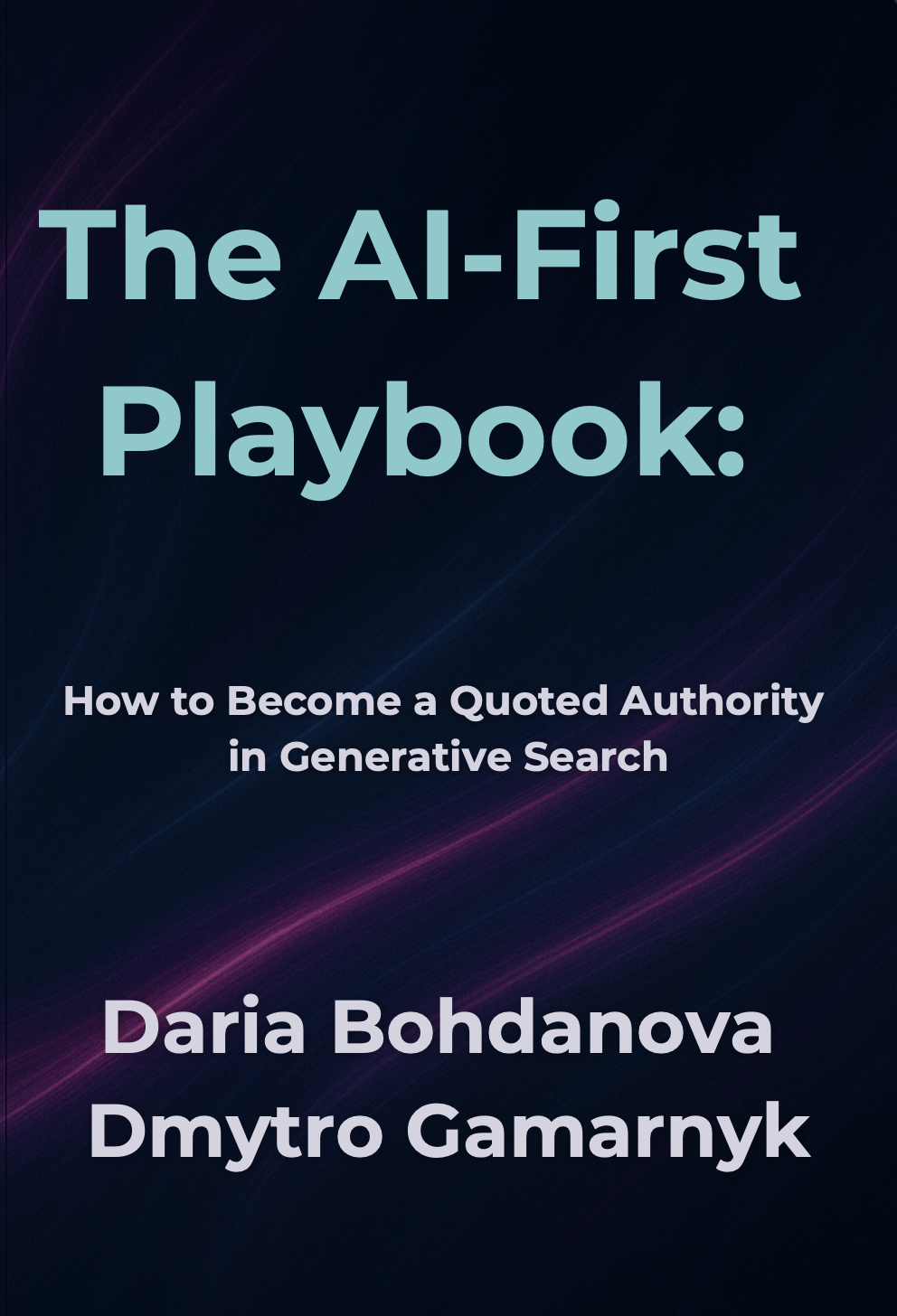
The AI-First Playbook
The book extends the same principle beyond documentation: expertise becomes more visible when it is structured clearly enough for people, search engines, and generative systems to interpret without losing meaning.
View the book on AmazonContinue Through the ScriptWise Knowledge Hub
Frequently Asked Questions
Should documentation be written differently for AI?
The source should still be written for real users, but with stronger structure, explicit context, stable terminology, and retrievable sections. Those qualities improve both human usability and machine interpretation.
Can generated API reference replace a technical writer?
No. Generated reference describes the contract. A technical writer connects that contract to tasks, concepts, examples, edge cases, migration paths, and user decisions.
What is the best format for product documentation?
There is no universal format. The right system depends on product complexity, audience, contribution model, versioning, reuse, localization, and publishing requirements.
How does documentation reduce support costs?
It reduces avoidable uncertainty before escalation, improves self-service, shortens troubleshooting, and gives support teams a stable source for consistent answers.
What makes documentation senior-level work?
Senior work includes product discovery, architecture, governance, stakeholder alignment, tooling decisions, release integration, measurement, and risk management—not only polished prose.
Leave a Reply